
Rare-earth ions have highly localized 4f electrons that can give rise to magnetic moments and characteristic luminescence. Most rare-earth ions in solids are trivalent. In some divalent compounds, the energy separation between the 4f and 5d states is small enough for visible or near-infrared light to drive 4f–5d transitions. Divalent thulium (Tm2+) shares its 4f13 electron configuration with trivalent ytterbium (Yb3+) and combines localized magnetic moments with near-infrared 4f–4f transitions and low-energy 4f–5d excitations. Most work on Tm2+ has focused on molecular complexes and doped materials. How its 4f moments behave in an extended solid, and whether low-energy excitation can generate a measurable optical response, remain open questions.
Professor Ningxin Jiang of Nanjing University’s School of Chemistry, Professor Shuang Chen of its Kuang Yaming Honors School, and Professor Zhaobo Hu of Jiangxi University of Science and Technology compared layered thulium diiodide (TmI2) with two Tm2+ reference materials. In TmI2, localized 4f moments dominate the low-temperature magnetism. Compared with the references, TmI2 absorbs at lower energies through 4f–5d transitions, emits more weakly, and shows a stronger current response under near-infrared illumination.
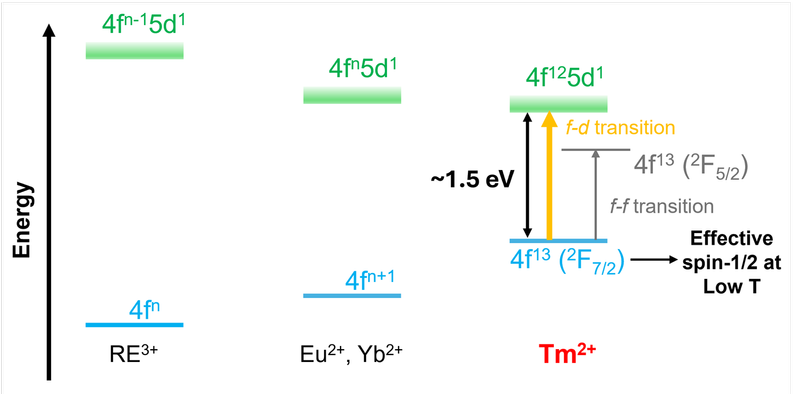
Figure 1. Schematic 4f and 5d energy levels of trivalent rare-earth ions, selected divalent rare-earth ions, and Tm2+.
Single-crystal diffraction showed that edge-sharing TmI6 octahedra form layers in which Tm2+ ions occupy a regular triangular lattice. The team used Cs4TmI6, which contains isolated TmI6 octahedra, and dilute Tm2+-doped SrI2 (SrI2:Tm2+) as references. This allowed them to compare Tm2+ in a connected lattice, in isolated coordination units, and as a dilute dopant.
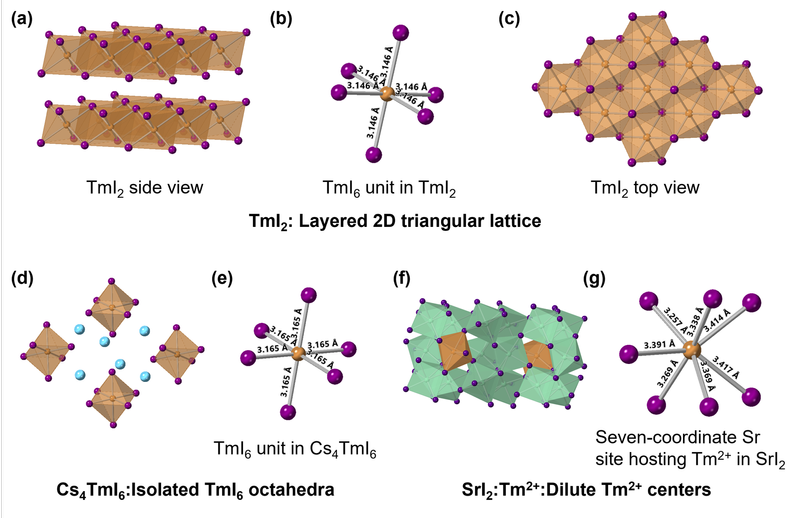
Figure 2. Crystal structures and local coordination environments of TmI2, Cs4TmI6, and SrI2:Tm2+.
Ultraviolet–visible–near-infrared diffuse reflectance spectra showed a narrow absorption feature near 1138 nm in all three Tm2+-containing materials, assigned to a 4f–4f transition. All three also showed broad 4f–5d absorption extending into the near infrared, with two components near 657 and 760 nm in TmI2. Applying the same analysis to the absorption edges gave apparent optical transition energies of 1.45, 1.56, and 1.76 eV for TmI2, Cs4TmI6, and SrI2:Tm2+, respectively. This comparison indicates that lower-energy light can access 5d-related excited states in layered TmI2.
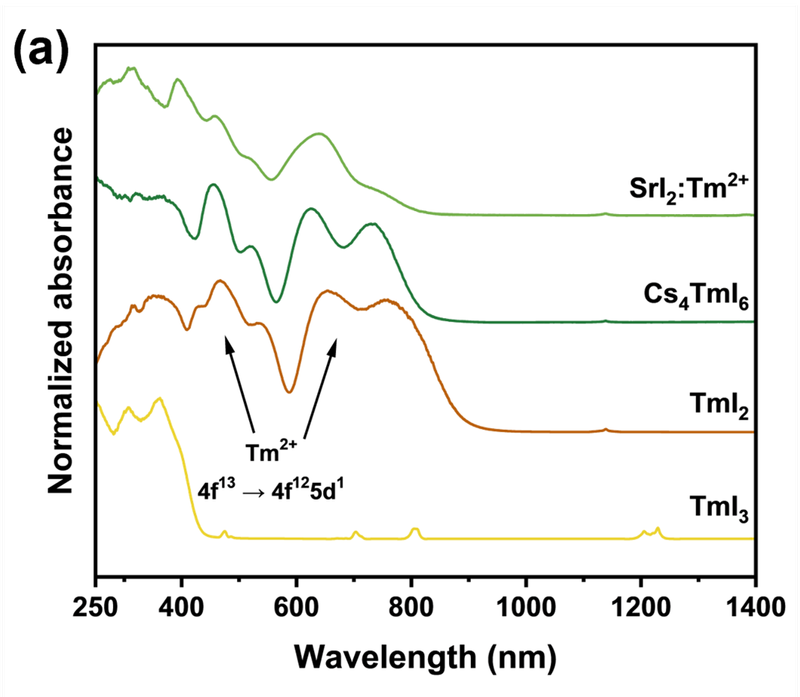
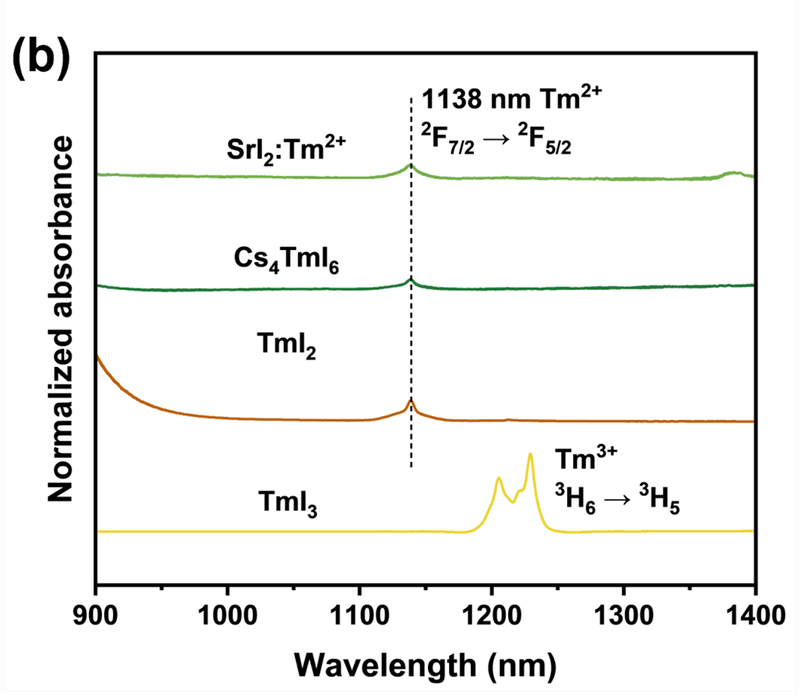
Figure 3. Diffuse reflectance spectra of thulium iodides (left) and an expanded view of the near-infrared region (right).
Density functional theory calculations showed that the occupied Tm 4f bands were narrow in all three materials, consistent with strongly localized 4f electrons. The low-lying unoccupied states in TmI2 and Cs4TmI6 derive primarily from Tm 5d and I 5p orbitals. The 5d-derived bands were more dispersive in layered TmI2 than in Cs4TmI6, which contains isolated octahedra. The difference shows how the connectivity of the coordination units can affect the 5d states.
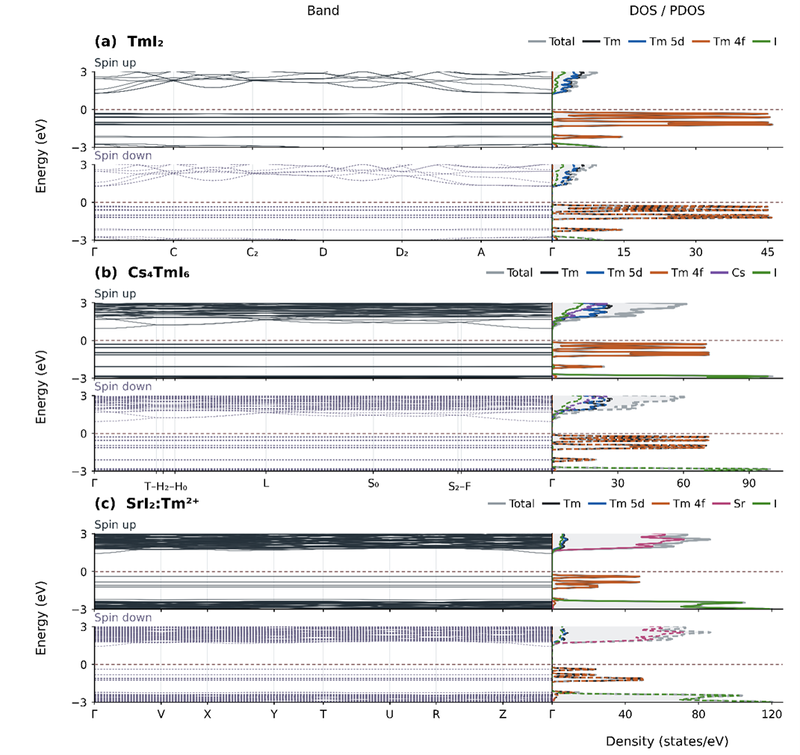
Figure 4. Spin-polarized band structures and projected densities of states for the three Tm2+-containing materials.
A fit to the magnetic susceptibility of TmI2 from 100 to 300 K gave an effective moment of about 4.82 μB per Tm, close to the value expected for a free Tm2+ ion. The low-temperature susceptibility and magnetization were consistent with a response dominated by the lowest Kramers doublet produced by crystal-field splitting. The low-temperature Weiss temperature of approximately −0.80 K is consistent with weak antiferromagnetic interactions. Susceptibility measurements down to 2 K showed no evidence of long-range magnetic order, and the magnetic heat capacity showed no sharp transition down to 3 K. The two reference materials showed similar magnetic responses, supporting a predominantly single-ion interpretation over the measured temperature range.
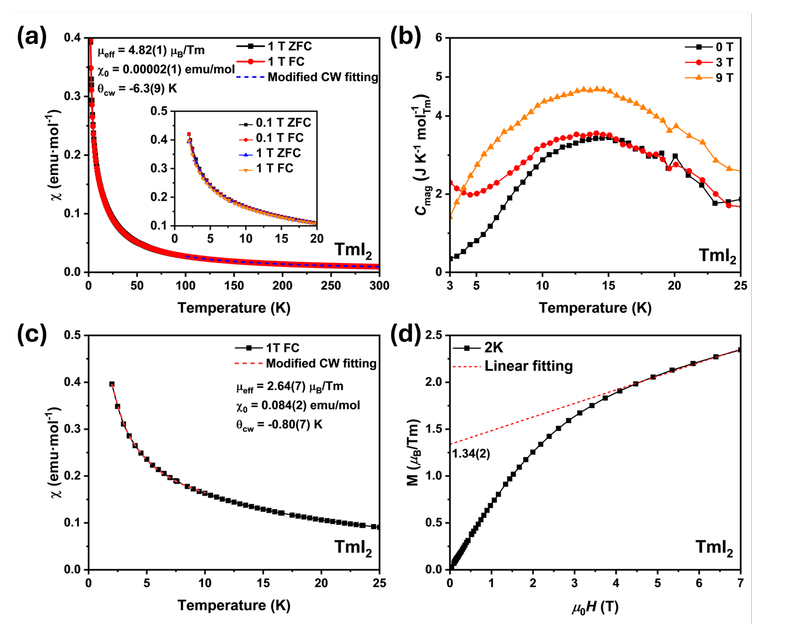
Figure 5. Magnetic susceptibility, magnetic heat capacity, and magnetization of layered TmI2.
Under 633 nm excitation, all three materials showed a narrow emission peak near 1143 nm at room temperature and 78 K, assigned to a Tm2+ 4f–4f transition. TmI2 showed weaker overall luminescence and a weak, broad emission band near 977 nm at 78 K. At the same temperature, Cs4TmI6 showed two broad peaks near 834 and 932 nm, and SrI2:Tm2+ showed a broad peak near 805 nm. These broad emissions were tentatively assigned to 5d–4f transitions. Their differing peak positions reflect the sensitivity of the 5d-related excited states to local coordination and the lattice environment.
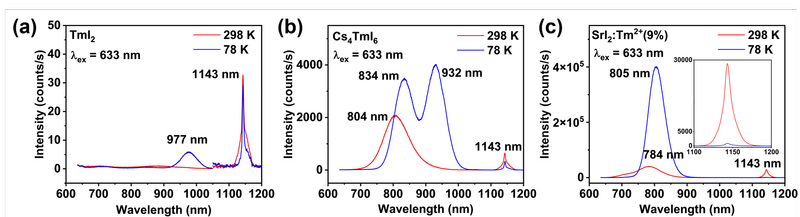
Figure 6. Near-infrared photoluminescence spectra of the three Tm2+-containing materials (a–c).
In the dark at room temperature, a pellet pressed from ground TmI2 single crystals had a resistivity of about 4.3 × 10¹⁰ Ω·cm. Its resistance decreased as the temperature rose. At an incident power density of 0.5 W/cm2, periodic 808 nm illumination produced a reproducible current response in a TmI2 powder pellet at biases from 1 to 10 V. At 10 V, the current rose from about 40 pA in the dark to 240 pA under illumination, roughly six times the dark current. Under the same conditions, 1064 nm illumination increased the current by about 16%.Neither reference material showed a clear current response above background fluctuations under 808 nm illumination. The stronger response of TmI2 at 808 nm than at 1064 nm is consistent with its stronger 4f–5d absorption at 808 nm.
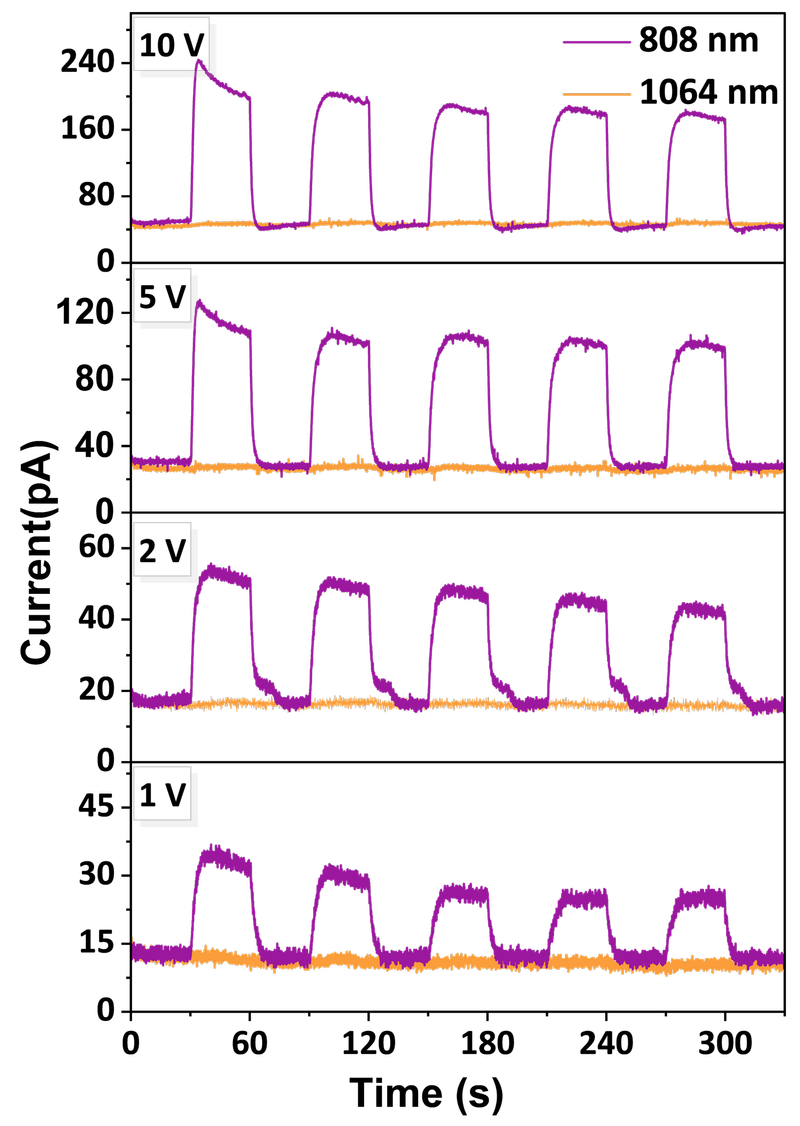
Figure 7. Current response of a TmI2 powder pellet to 808 and 1064 nm illumination at different applied biases.
The study extends research on 4f13 triangular-lattice magnets from established Yb3+ systems to divalent rare-earth halides. With both localized magnetic moments and low-energy states accessible by near-infrared excitation, layered TmI2 provides a material for investigating low-temperature magnetism and how lattice connectivity affects luminescence and light-induced current.
The findings were published in the Journal of the American Chemical Society under the title “Localized 4f Magnetism and Low-Lying 5d-Mediated Photoresponses in Layered TmI2” Hao Ni of Nanjing University’s School of Chemistry is the first author. Zhaobo Hu, Shuang Chen, and Ningxin Jiang are the corresponding authors. Weigao Xu’s group at Nanjing University’s School of Chemistry also contributed to the study.
The work was supported by startup funds from Nanjing University, the National Natural Science Foundation of China, the Natural Science Foundation of Jiangxi Province, the Fundamental and Interdisciplinary Disciplines Breakthrough Plan of China’s Ministry of Education, and the State Key Laboratory of Coordination Chemistry.
Read the paper https://doi.org/10.1021/jacs.6c15247