
Proteins are the fundamental building blocks of all living organisms. Their amino acid sequences, three-dimensional structures and diverse post-translational modifications generate information far more complex than genomic data. Developing novel single-molecule protein sequencing techniques with high sensitivity, has become an urgent priority for proteomics research in the post-genomic era. The mature advancement of nanopore nucleic acid sequencing has inspired researchers to adapt this platform to protein sequencing. Nevertheless, proteomic analysis faces multiple inherent challenges, including sophisticated high-order structures, the combination of 20 canonical amino acids, abundant post-translational modifications and splicing variants, creating an enormous volume of distinguishable molecular signals. To date, robust and universal nanopore protein sequencing techniques remain elusive.
Controlled enzymatic digestion of native proteins yields complex mixtures consisting of amino acids, short and long peptides, and modified peptides. These fragments retain abundant information about the protein sequence, mutations and post-translational modifications, converting the intractable task of protein analysis into the straightforward identification of short, easily characterized peptide segments. This approach lays a viable foundation for single-molecule proteomic profiling. Recently, Prof. Shuo Huang’s group reported an innovative strategy for nanopore peptide analysis (Figure 1). They site-specifically functionalized the constriction region of Mycobacterium smegmatis porin A (MspA) nanopore with a single nitrilotriacetic acid-nickel (NTA-Ni) adapter. The immobilized nickel ion form coordination bonds with peptide N-termini, enabling transient immobilization of peptides (Figure 1a). Unlike conventional sensing strategies that rely on peptide translocation, this anchoring mechanism effectively suppresses random peptide thermal motion and drastically prolongs event duration. It addresses a long-standing technical bottleneck where short peptides translocate too rapidly to be resolved, generating highly distinct current signatures for unambiguous peptide identification.
Built upon this high-resolution sensing platform, the researchers introduced endopeptidases to achieve controlled cleavage of target peptides. Distinct nanopore events were produced by different hydrolytic fragments, collectively forming unique molecular fingerprints that enable rapid peptide identification without requiring a reference database (Figure 1b). They further constructed a comprehensive nanopore event library for peptides. By matching characteristic signals from overlapping fragments generated via multi-enzyme digestion, the original peptide sequence can be accurately reconstructed (Figure 1c). This method also pinpoints single amino acid substitutions, deletions and post-translational modification sites with single-residue precision.
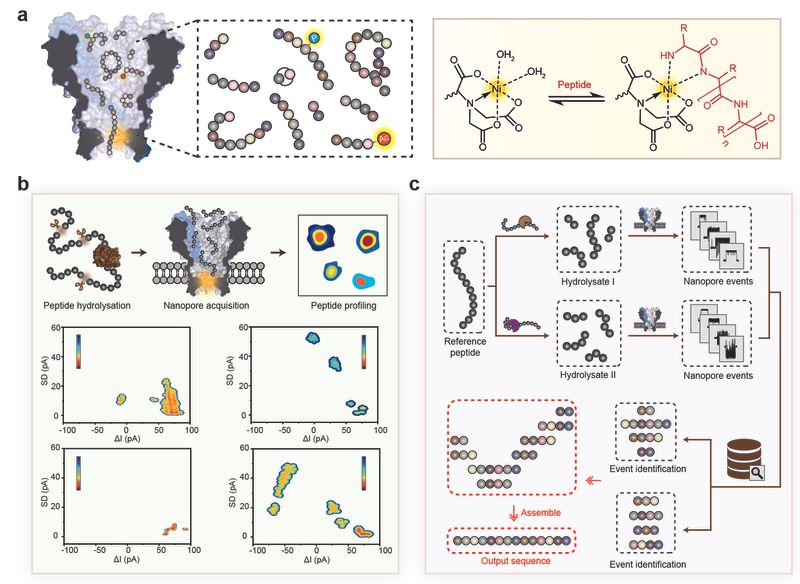
Figure 1. Schematic illustration of peptide detection and sequence assembly using engineered MspA nanopore.
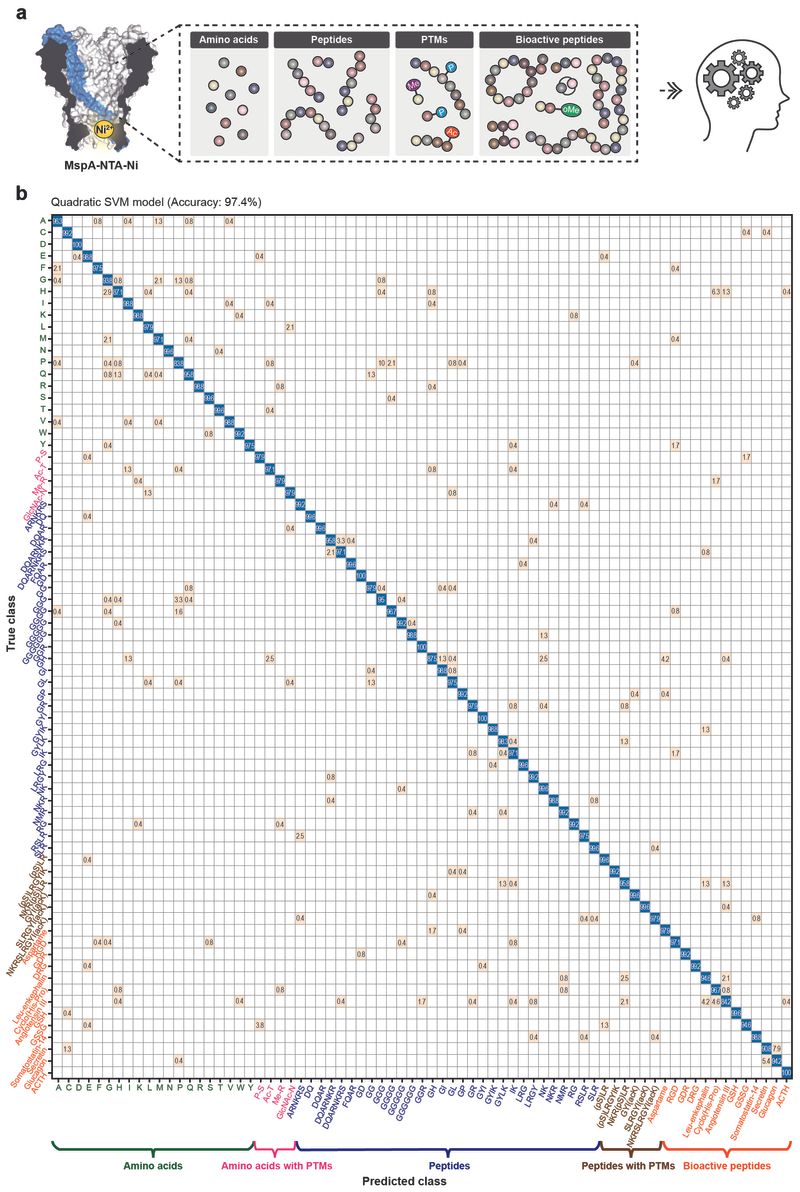
Figure 2. Broad-spectrum nanopore detection covering 73 analytes including amino acids, unmodified and modified peptides.
The related paper titled “High-resolution nanopore peptide sensing, profiling and sequence assembly” was published in Nature Nanotechnology on June 15, 2026 (paper link: https://doi.org/10.1038/s41565-026-02192-3). Prof. Shuo Huang is the corresponding author, and Dr. Kefan Wang is the first author. This research was supported by the State Key Laboratory of Analytical Chemistry for Life Science and the Nanjing University Chemistry and Biomedicine Innovation Center (ChemBIC), and funded by the National Key R&D Program of China, National Natural Science Foundation of China, Fundamental Research Funds for the Central Universities, China Postdoctoral Science Foundation.