
Aberrant sialylation on the surface of tumor cells is a hallmark of cancer progression and immune evasion. Abundant terminal sialoglycans interact with sialic acid-binding immunoglobulin-like lectins (Siglecs) on immune cells, forming a glyco-immune checkpoint analogous to the PD-1/PD-L1 axis. This interaction suppresses antitumor immune effectors including T cells, natural killer (NK) cells, and macrophages. In recent years, disrupting the sialoglycan-Siglec interaction has emerged as a promising direction for cancer immunotherapy. However, current strategies—such as Siglec-blocking antibodies and sialidase-based therapies—suffer from limitations including poor stability, immunogenicity, limited tumor selectivity, and low in vivo delivery efficiency. Developing new approaches that enable precise glycan editing within the tumor microenvironment while simultaneously activating antitumor immunity is therefore of great significance.
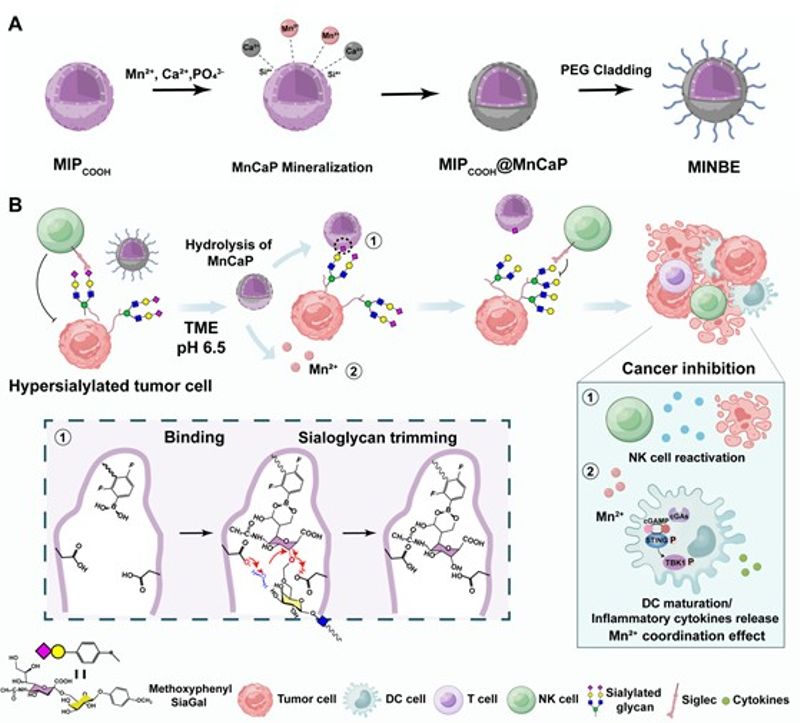
Figure 1. Schematic illustration of the synthesis of MINBE and its acidic tumor microenvironment-triggered glycoimmune therapy mechanism.
To address these challenges, Professor Zhen Liu’s team, drawing on their long-standing expertise in molecular imprinting and biomimetic molecular recognition, has developed a molecularly imprinted nanobiomimetic enzyme (MINBE). This platform uses a sialic-acid-containing disaccharide as a template to construct an imprinting nanocore with specific recognition and catalytic functions. A pH-responsive manganese calcium phosphate (MnCaP) mineral layer and a PEG shielding layer are further introduced to enhance in vivo circulation stability and reduce non-specific interactions in normal tissues. In the acidic tumor microenvironment, the outer MnCaP layer undergoes responsive dissociation, exposing the imprinting cavities that function as glycosidase mimetics. These cavities selectively trim tumor-associated sialoglycans, thereby disrupting sialoglycan-Siglec-7/9-mediated immunosuppression. Concurrently, the released Mn²⁺ ions promote dendritic cell activation, further enhancing antigen presentation and antitumor immune responses.
Experimental results demonstrate that MINBE effectively removes sialic acid from tumor cell surfaces in vitro, blocks the interaction between Siglec-7/9 and sialoglycans, and restores NK cell-mediated killing of tumor cells. In a mouse model of 4T1 triple-negative breast cancer, MINBE exhibits favorable tumor accumulation and biocompatibility, significantly suppresses tumor growth, and promotes intratumoral immune cell infiltration and dendritic cell maturation. This work presents a programmable glycan-editing strategy enabled by molecular imprinting and offers a new approach for intervening in glyco-immune checkpoints and developing novel cancer immunotherapies.
The findings have been published in Angewandte Chemie International Edition under the title "A Bioinspired Nanozyme Enables Glycoimmune Therapy via Precision Sialoglycan Trimming" (DOI: 10.1002/anie.1539868). Professor Zhen Liu of the School of Chemistry at Nanjing University is the corresponding author, and Dr. Peixin Guan, a Ph.D. graduate from the group, is the first author. This research was supported by grants from the National Natural Science Foundation of China (NSFC).
Link to the paper:
https://doi.org/10.1002/anie.1539868