
High-purity fluorinated electronic gases (>5N) are indispensable to semiconductor manufacturing, and their purity and supply security directly affect chip fabrication precision, device performance, and supply-chain stability. Octafluoropropane (C3F8), with its excellent chemical stability and plasma-etching properties, is widely used in advanced chip manufacturing. However, industrial C3F8 is typically produced by fluorination of hexafluoropropylene (C3F6), and the product usually contains 1–10% residual C3F6, making it difficult to meet the stringent electronic-grade purity requirement (>99.999%). Because C3F6 and C3F8 have extremely similar boiling points (236.3 vs 242 K), conventional cryogenic distillation generally requires an excessive number of theoretical plates, multiple distillation columns in cascade, and complex process configurations, resulting in high separation costs and substantial capital investment. In addition, these fluorinated electronic gases have low boiling points and high volatility, so their storage and transportation usually rely on pressurized liquefaction, which not only increases energy consumption but also introduces risks associated with high-pressure operation and gas leakage. Moreover, fluorinated specialty gases are commonly delivered under negative pressure during chip manufacturing; therefore, high-capacity release with high efficiency, stability, and controllability is also a key metric for evaluating gas-storage systems. Accordingly, achieving efficient purification, safe storage, and controllable release of fluorinated electronic gases has become a critical technological challenge for supporting the high-quality development of the semiconductor industry.
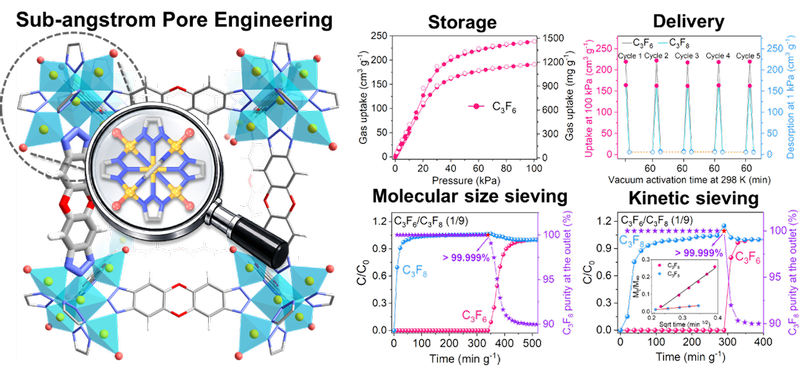
To address these challenges, Prof. Zhaoqiang Zhang’s Group developed a pore-engineering strategy to precisely regulate the pore structure and pore chemistry of microporous adsorbents at the sub-angstrom scale, thereby enabling ultrahigh-capacity storage, efficient delivery, and high-purity separation of fluorinated electronic gases. While preserving the intrinsic advantage of cage-like cavities for high gas-storage capacity, this strategy imparts the materials with excellent thermodynamic molecular recognition, size-sieving, and kinetic-sieving capabilities through precise tuning of pore-window dimensions, successfully integrating three normally difficult-to-reconcile properties—high-capacity storage, reversible and efficient release, and high-performance separation—within a single material platform. Among them, Co-MFU-4L and its derivatives exhibit record C3F6 and C3F8 storage capacities (>170 cm3/g), corresponding to gravimetric uptakes above 130 wt%, together with excellent adsorption–desorption reversibility and very low regeneration energy. They also show outstanding storage performance for other fluorinated electronic gases, such as C2F6 and CF3CH2F, highlighting their broad potential for the safe storage and controllable delivery of fluorinated specialty gases. Furthermore, by further tuning the pore-window size, Co-MFU-4 achieved breakthrough size-sieving separation of C3F6/C3F8, directly producing electronic-grade C3F8 (>99.999%, 3300 L/kg) from a C3F6/C3F8 (1/99) mixture. When the pore-window-limiting anion was changed from –Cl to –F, the separation mechanism switched from thermodynamically governed size sieving to diffusion-controlled kinetic sieving, delivering a kinetic selectivity as high as 60.6. This work not only reveals the structure–performance relationship between sub-angstrom pore-structure regulation and separation behavior, but also provides a new solution and technical pathway for the efficient purification, safe storage, and controllable release of fluorinated electronic gases.
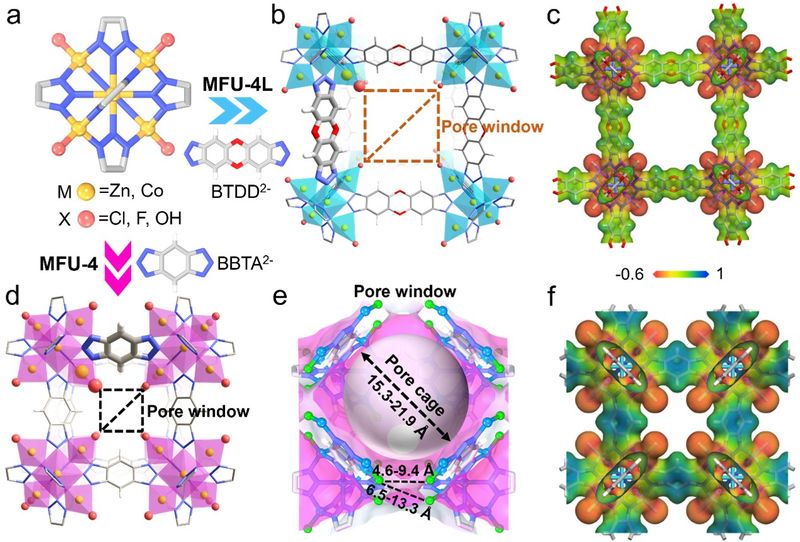
Figure 1. (a) Structural building units of MFU-4 and MFU-4L. (b and d) Three-dimensional frameworks of (b) MFU-4L and (d) MFU-4 (M, polyhedra; X, orange; O, red; N, blue; C, gray; H, white). (e) Pore architecture of MFU-4-type MOFs. (c and f) Electrostatic potential of Co-MFU-4L (c) and Co-MFU-4 (f).
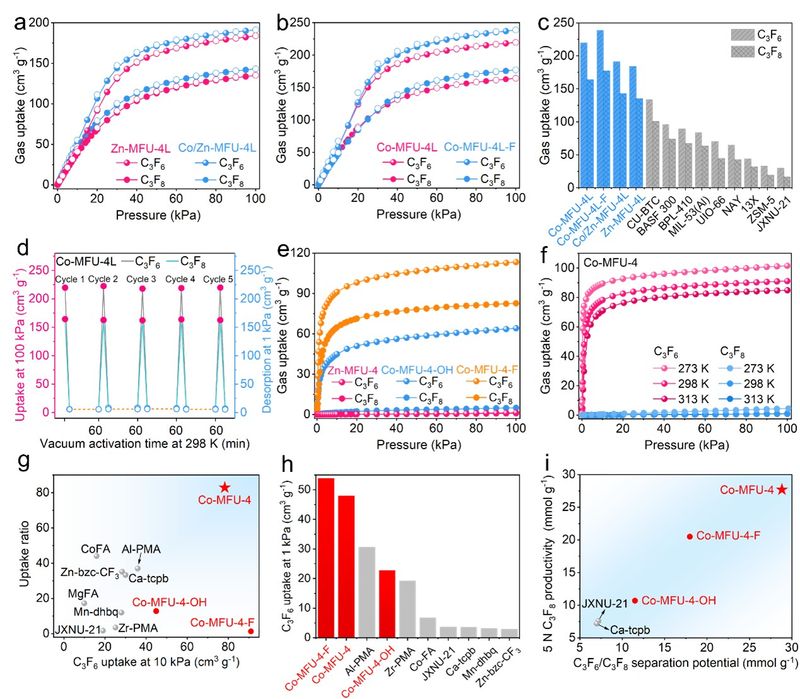
Figure 2. (a and b) Single component adsorption isotherms of C3F6 and C3F8 on MFU-4L materials at 298 K. (c) Comparison of the C3F6 and C3F8 adsorption capacities on various materials at 298 K and 100 kPa. (d) Cycling tests of Co-MFU-4L for C3F6 and C3F8 adsorption at 100 kPa and desorption at 1 kPa and 298 K. (e) Single component adsorption isotherms of C3F6 and C3F8 on Zn-MFU-4, Co-MFU-4-OH, and Co-MFU-4-F at 298 K. (f) Single component adsorption isotherms of C3F6 and C3F8 on Co-MFU-4 at different temperatures. (g) Comparison of C3F6 uptakes (10 kPa) and C3F6/C3F8 uptake ratio (100 kPa), and (h) low-pressure (1 kPa) C3F6 uptakes for reported materials. (i) Comparison of various porous materials based on their C3F6/C3F8 (1/9) separation potential and experimental C3F8 (>99.999 %, 5 N) productivity.
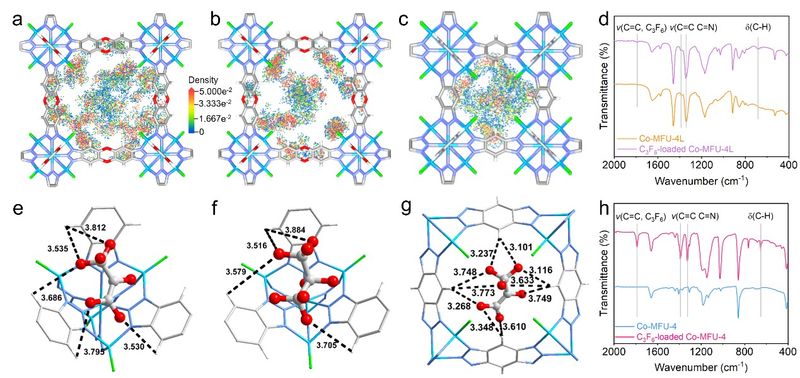
Figure 3. (a-c) Density distributions of (a) C3F6 and (b) C3F8 in Co-MFU-4L, and (c) C3F6 in Co-MFU-4 at 298 K and 100 kPa obtained from GCMC simulations (Note: b and c are sharing the same scale bar in a). (e-g) Optimal binding sites of (e) C3F6 and (f) C3F8 in Co-MFU-4L, and (g) C3F6 in Co-MFU-4. (d, h) FTIR spectra of activated and C3F6-adsorbed (d) Co-MFU-4L and (h) Co-MFU-4.
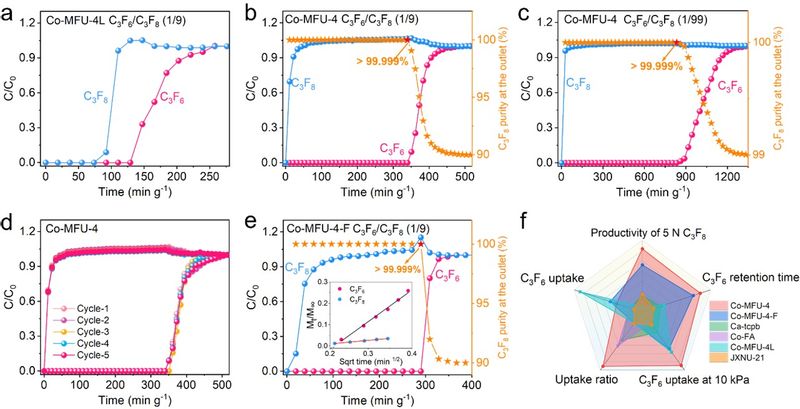
Figure 4. (a) Breakthrough curves of C3F6/C3F8 (1/9) on Co‐MFU‐4L. (b and c) Breakthrough curves of C3F6/C3F8 (1/9 and 1/99) on Co‐MFU‐4. (d) Cyclic breakthrough curves of C3F6/C3F8 (1/9) on Co‐MFU‐4. (e) Breakthrough curves of C3F6/C3F8 (1/9) on Co‐MFU‐4-F, and the inserted figure shows the linear fitting of the kinetic sorption profiles. (f) Comparison of the overall C3F6/C3F8 separation performance of Co‐MFU‐4 with other state-of-the-art materials. Note: all experiments were conducted at 298 K; flow rates of 2.0 and 4.0 mL min-1 were used for 1/9 and 1/99 C3F6/C3F8 mixtures, respectively.
This work demonstrates that sub-angstrom regulation of pore structures in MFU-4-type microporous materials enables the integration of high-capacity storage, controllable release, and precise C3F6/C3F8 separation within a single platform, overcoming the long-standing trade-off among storage, delivery, and separation. The results identify cavity size and pore-window structure as the key determinants of performance: large cage-like cavities enhance gas uptake and transport, while contracted pore windows strengthen molecular recognition and sieving of the highly similar C3F6 and C3F8 molecules. In addition, precise tuning of terminal functional groups allows the separation mechanism to switch between thermodynamic and kinetic sieving, highlighting excellent structural tunability. Overall, this study presents a pore-engineering strategy for fluorinated electronic gases, providing a new materials solution for low-energy storage, safe delivery, and high-purity separation. It also establishes a clear structure–property relationship linking pore structure, interfacial chemical environment, and separation performance, offering guidance for the rational design of porous materials for complex gas systems.
This work entitled “Fine-tuned Pore Architectures in Microporous Metal-Organic Frameworks for Benchmark Storage and Purification of Fluorinated Propylene and Propane” has been published on Advanced Materials (https://doi.org/10.1002/adma.73068). This project was supported by the National Natural Science Foundation of China (No. 92475102, 22408152, and 22408046), the Natural Science Foundation of Jiangsu Province (No. BK20241328), the Fundamental Research Funds for the Central Universities (No. 2024300381 and KG202510), and Open Fund of Key Laboratory of Green and High-end Utilization of Salt Lake Resources (No. ISL2024-11).