
The excellent electrical, thermal and catalytic properties of metallic elements make them play an irreplaceable role in many industrial fields. Apart from the industrial applications, metallic elements also play a crucial role in environmental stability. For example, Mg2+ is crucial for photosynthesis and the carbon cycle, thereby maintaining ecological balance. On the contrary, heavy metal ions pose significant risks: even at extremely low concentrations, they can damage aquatic ecosystems and accumulate in the food chain, threatening biodiversity and human health. On July 1st, 2025, a severe lead poisoning incident occurred at a kindergarten in Tianshui City, Gansu Province. The use of unqualified food additives resulted in abnormal blood lead levels in several children. Therefore, monitoring the concentration and form of metal ions is of vital importance for maintaining ecological balance and human health.
The traditional methods for detecting metal ions each have their advantages and disadvantages. Atomic absorption spectrometry (AAS), as a fundamental technique, is widely used in the analysis of elemental composition, but it is difficult to achieve synchronous detection of multiple elements. Inductively coupled plasma mass spectrometry (ICP-MS) features extremely high sensitivity, low detection limits and multi-element analysis capabilities, but it requires relatively high costs and professional operational skills. These technologies usually rely on bulky instruments, require complex operations, and are difficult to balance sensitivity and portability. Therefore, it is still necessary to develop a portable, rapid and cost-effective strategy to address these challenges. This strategy can integrate functions such as high sensitivity, ease of use and portability to achieve efficient detection of metal ions.
Recently, Professor Shuo Huang's group has achieved simultaneous discrimination of common divalent metal ions (M2+) using a hetero-octameric Mycobacterium smegmatis porin A (MspA) nanopore. In this work, they successfully identified ten common M2+ by optimizing the nanopores, demonstrating the excellent spatial resolution of MspA nanopores. They found that when Cu2+ was used as the model analyte, the MspA nanopore modified with a nitrilotriacetic acid (NTA) adapter (MspA-NTA) had a strong coordination interaction with Cu2+, resulting in an irreversible binding process. In contrast, the coordination interaction between the MspA nanopore modified with an iminodiacetic acid (IDA) adapter (MspA-IDA) and Cu2+ is relatively weak, enabling reversible detection of Cu2+ (Figure 1). The results show that, compared with MspA-NTA, MspA-IDA is more suitable as a sensor for detecting M2+.
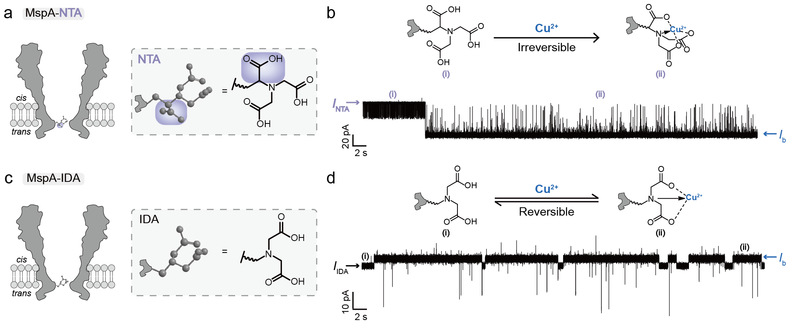
Fig.1: Nanopore screening
The research team introduced a single IDA adapter at the pore constriction to construct an MspA-IDA sensor (Figure 2). Based on the coordination interaction between IDA adapter and M2+, they successfully detected ten common M2+ using the MspA-IDA nanopore, including Sn2+, Cu2+, Pb2+, Cd2+, Mn2+, Zn2+, Fe2+, Co2+, Mg2+, and Ni2+. The experimental results show that during the detection process, each M2+ generates a specific nanopore event, and the machine learning recognition accuracy rate reaches 99.6%. Compared with the previous nanopore methods that could only detect a few M2+, this strategy is relatively simple and successfully expands the ability to detect M2+ to ten types, which is the largest number reported in this field to date.
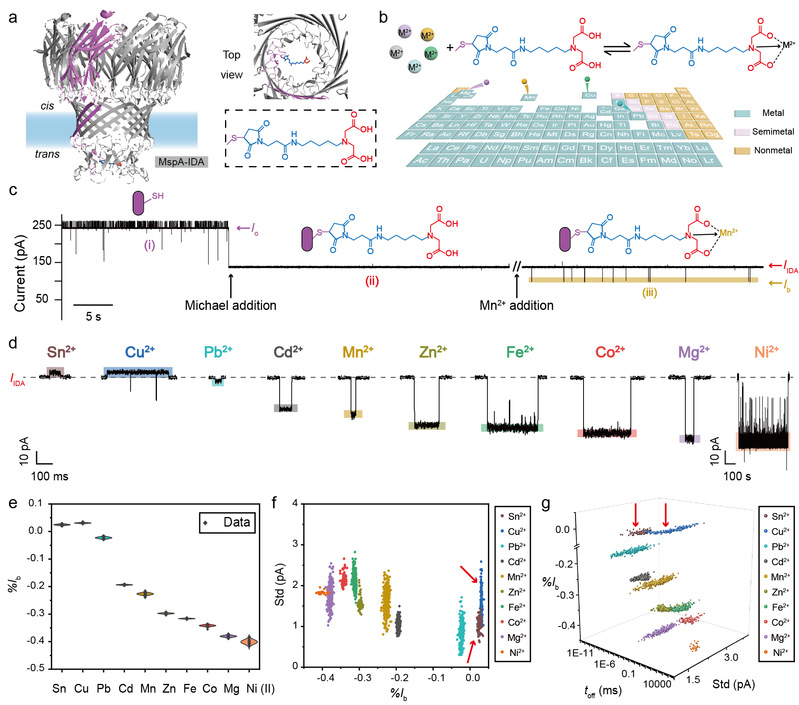
Fig.2: Nanopore analysis of M2+ using MspA-IDA
Subsequently, they applied this strategy to the M2+ analysis of natural water samples, promoting the practical application of nanopore technology (Figure 3). They collected water samples from different locations respectively. With the assistance of the nanopore platform, they successfully identified the types and contents of M2+ contained in different natural water samples. This method can rapidly analyze M2+ in natural water samples, providing tools for sustainable water resource management, pollution control and ecological protection.
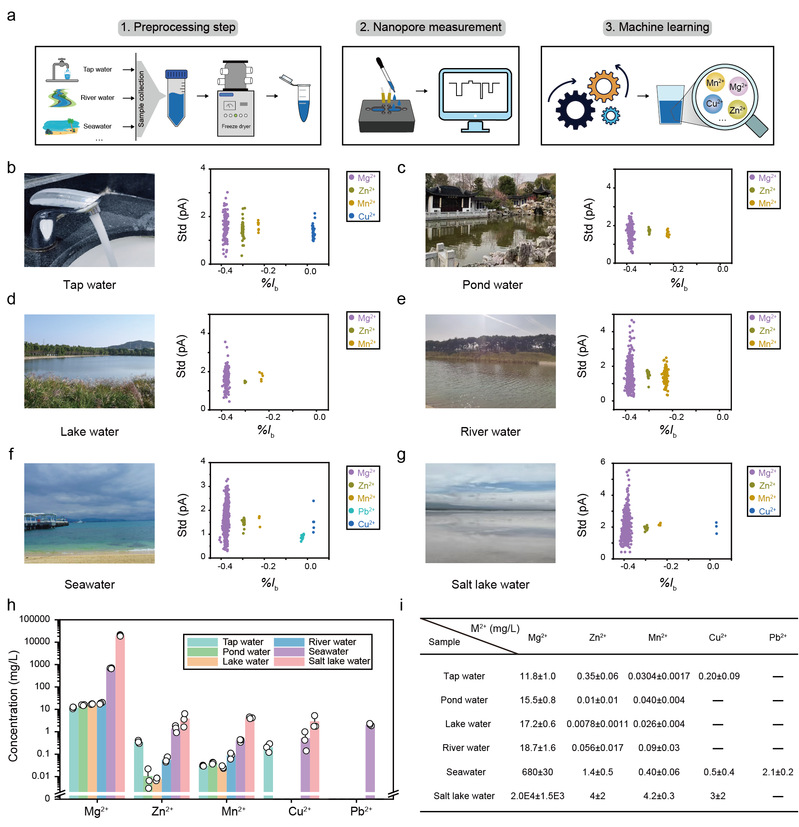
Fig.3: Nanopore analysis of M2+ in natural water samples
The related paper entitled “Iminodiacetic acid modification enables nanopore identification of major divalent metal ions in natural water samples” has been published on Nature Water on January 6th, 2026 (paper link:https://doi.org/10.1038/s44221-025-00544-2). Prof. Shuo Huang from our department is the corresponding author. Ph.D. students Wen Sun from our department is the first author. This project was funded by the National Key R&D Program of China (grant no.2022YFA1304602 and no. 2023YFF1205900), National Natural Science Foundation of China (grant no. 22225405, 22225404 and no. 223B2402), the Fundamental Research Funds for the Central Universities (grant no. 020514380336).