
The cathodic hydrogen evolution reaction (HER) in water electrolysis proceeds via the formation of surface-bound hydrogen intermediates (H*) through the Volmer step, followed by their subsequent coupling in either the Heyrovsky or Tafel step. Reducing the activation barriers associated with these elementary processes through judicious catalyst design is essential for enhancing HER performance. In practical electrolytic systems—particularly under neutral conditions or during direct seawater electrolysis—the pH at the electrolyte/catalyst interface often undergoes pronounced fluctuations, which become even more severe at industrial-level current densities. Consequently, ensuring a controllable, stable, and efficient supply of H* intermediates under such dynamically varying pH environments holds both fundamental and technological importance.For proton-blocking metals such as Ru, Pt, and Ir, proton reduction and H* coupling occur exclusively at the catalyst surface. As a result, both H* coverage and the operative HER pathway are highly sensitive to local pH, thereby limiting the pH-Universal operability of these catalysts. In contrast, non–proton-blocking transition-metal oxides (e.g., WO₃, MoO₃) can accommodate protons under electrochemical conditions to form lattice hydrogen, effectively functioning as a “hydrogen reservoir.” Establishing an efficient hydrogen-cycling transport channel between such a non-proton-blocking lattice-hydrogen host and a proton-blocking metal catalyst would enable continuous shuttling of lattice hydrogen to the metal surface, where it participates directly in HER. This strategy could significantly mitigate-or even fully eliminate-the dependence of H* formation on electrolyte pH, thereby enabling high-performance HER across the entire pH range.
Recently, the research group of professor Zheng Hu at the Key Laboratory of Mesoscopic Chemistry of MOE has leveraged a lattice-hydrogen cycling strategy to decouple adsorbed hydrogen intermediates (H*) from the electrolyte pH. Through this approach, they constructed an integrated catalyst comprising a proton-blocking metal (Ru) interfaced with a non-proton-blocking, lattice-hydrogen-rich host (HxWO₃), thereby enabling highly efficient hydrogen evolution across the entire pH spectrum at industrial-level current densities. Thermal pre-hydrogenation produced a lattice-hydrogen-enriched “hydrogen reservoir” in the form of hydrogen-rich tungsten oxide nanoneedles (HxWO₃ NN). Subsequent deposition of proton-blocking Ru nanoparticles yielded the Ru-HxWO₃ NN. In situ Raman spectroscopy, isotopic labeling studies, and first-principles simulations collectively demonstrate that lattice hydrogen in HxWO₃ can rapidly migrate to Ru active centers via a low-barrier path to participate in the hydrogen evolution reaction. The consumed hydrogen is spontaneously replenished on HxWO₃ through proton adsorption under acidic conditions or water dissociation under neutral and alkaline media. This dynamic replenishment effectively mitigates the strong pH dependence of H* coverage typically observed on proton-blocking metals. As a consequence, the Ru-HxWO₃ NN catalyst exhibits outstanding full-pH HER activity at an industrial current density of 1 A cm⁻², requiring overpotentials as low as 125, 219, and 142 mV in 0.5 M H₂SO₄, 1 M PBS, and 1 M KOH, respectively, while maintaining exceptional durability over 500 hours of continuous operation at 1 A cm⁻². This work forges a direct link between fundamental mechanistic insight and industrial relevance, and it offers a compelling design paradigm for the development of next-generation full-pH hydrogen-evolution electrocatalysts.
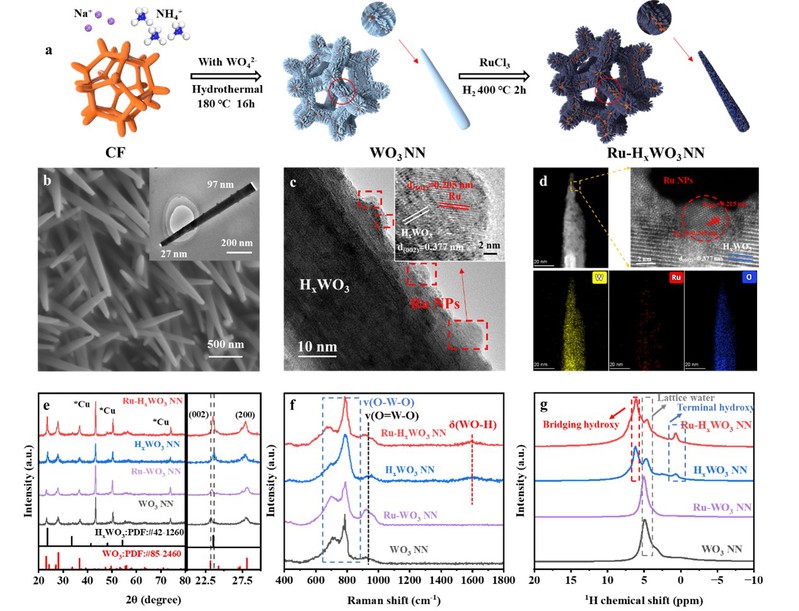
Figure 1. Preparation and characterizations of Ru-HxWO3 NN. a Schematic preparation route. b,c SEM (b) and HRTEM images (c). Insets are the corresponding TEM image and local enlargement. d HAADF-STEM image and corresponding EDS elemental mappings of W, Ru, and O. e XRD pattern and local enlargement in the range of 20°-30°. f Raman spectrum. g 1H NMR spectrum.
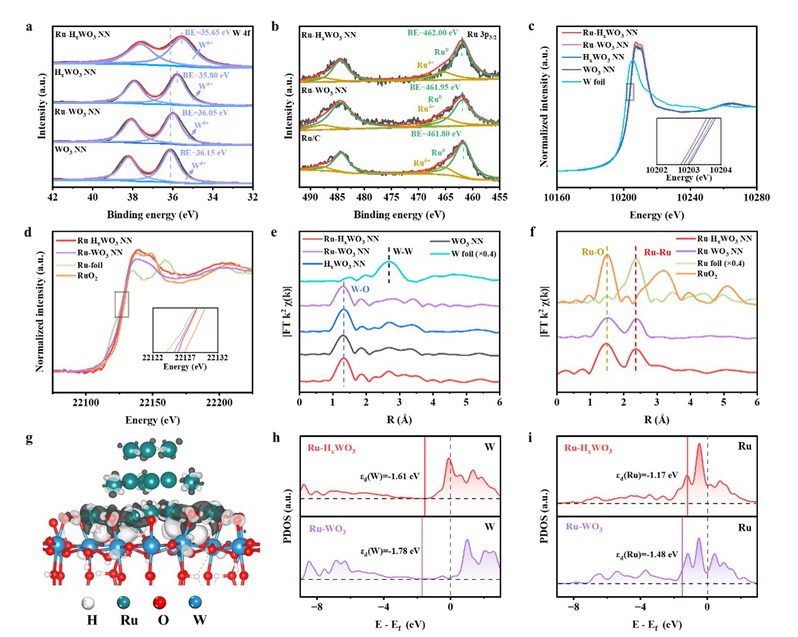
Figure 2. Electronic structure characteristics of Ru-HxWO3 NN, Ru-WO3 NN, WO3 NN, and HxWO3 NN. a,b W 4f and Ru 3p3/2 spectra, respectively. For comparison, the spectrum for commercial Ru/C is presented in (b). c,d W L3-edge and Ru K-edge XANES spectra, respectively. For comparison, the spectrum for W foil is presented in (c), and those for Ru foil and RuO2 are presented in (d). The marks in (c) and (d) is local enlargement. e,f Corresponding k2-weighted R-space Fourier transformed EXAFS spectra for W (e) and Ru (f). g Charge difference density. Black and white regions represent electron depletion and accumulation, respectively. The isosurface value is set at 0.01. h,i The PDOS curves of 3d orbitals of W (h) and Ru (i) atoms in Ru-HxWO3 NN and Ru-WO3 NN. The d-band centers of the corresponding metal are marked in black font.
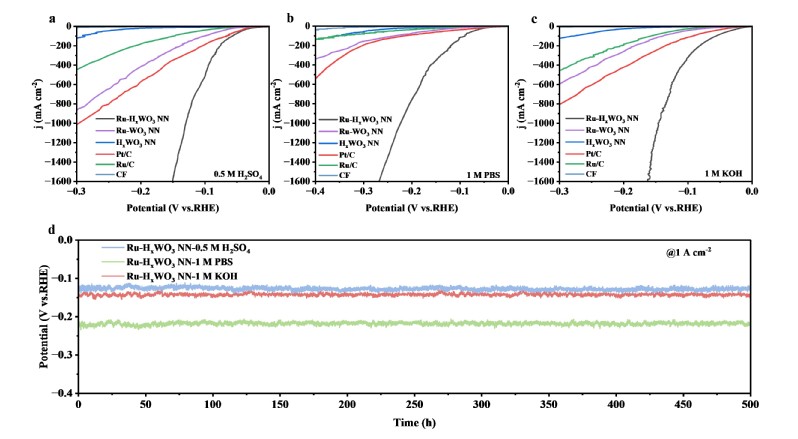
Figure 3. pH-universal HER performances of Ru-HxWO3 NN, Ru-WO3 NN, and HxWO3 NN in 0.5 M H2SO4, 1 M PBS and 1 M KOH. a-c Polarization curves. d CP curves of Ru-HxWO3 NN at the current density of 1 A cm-2 for 500 h. Note: The data of Pt/C, Ru/C and CF in (a-c) are presented for comparison.
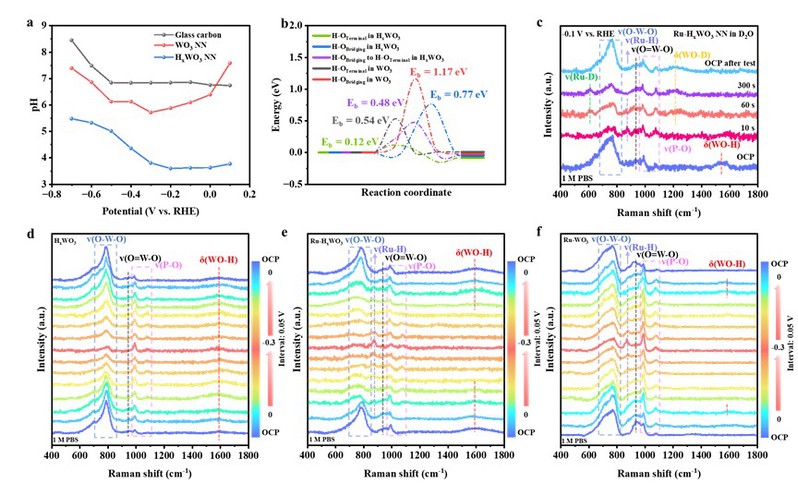
Figure 4. The behavior of lattice-hydrogen in Ru-HxWO3 NN and HxWO3 NN. a Local pH values on the surfaces of HxWO3 NN, WO3 NN and GC at different potentials in 0.1 M PBS with pH of 7.02. b Calculated energy barrier diagram for H migration. c In situ Raman spectra of Ru-HxWO3 NN at -0.1 V in 1 M PBS D2O solution at different stages of HER. d-f In situ Raman spectra of HxWO3 (d), Ru-HxWO3 (e) and Ru-WO3 (f) NN in 1 M PBS solution at different potentials. Note: The Raman signals at ~985 and ~1075 cm-1 are attributed to the symmetric P-O stretching mode of PO43- from the electrolyte
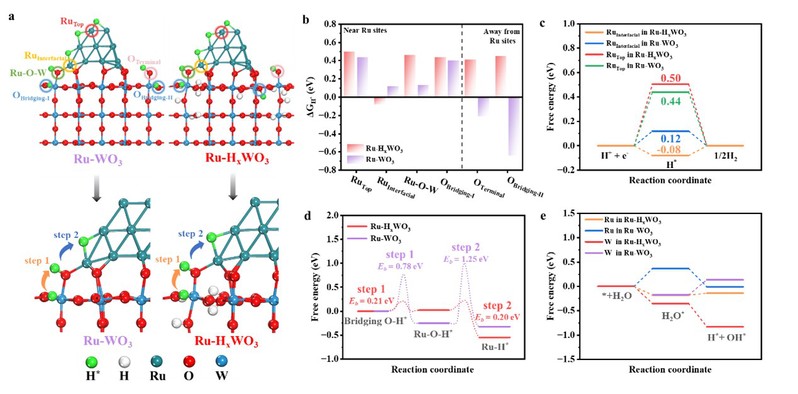
Figure 5. DFT calculation of the dynamic migration and replenishment of lattice-H. a,b Schematic diagram of different sites for H adsorption and migration near the interface (a) and corresponding adsorption free energy (b) in Ru-WO3 and Ru-HxWO3. c Free energy profiles for HER on Ru sites in Ru-HxWO3. d Hydrogen migration energy barriers corresponding to step 1 and step 2 in (a). e Free energy profiles for water dissociation on Ru and W sites in Ru-WO3 and Ru-HxWO3.
The related paper entitled “Lattice-hydrogen cycling mechanism enables pH-universal hydrogen evolution at ampere-level current densities”has been published on Nature communications on December 3, 2025(Paper link: https://doi.org/10.1038/s41467-025-65909-3,DOI:10.1038/s41467-025-65909-3).Ph.D. student Yan Zhang and Biao Feng are the co-first authors of this paper. Prof. Zheng Hu, Prof. Qiang Wu and Prof. Hongwen Huang from our department are co-corresponding authors. This work was jointly supported by the National Key Research and Development Program of China grant (2021YFA1500900(Z.H.), 2024YFA1208900(X.W.)), the National Natural Science Foundation of China grant (52071174(Z.H.), 22322902(H.H.), 22479073(Q.W.)), Major Science and Technology Project of Jiangsu Province grant BG2024033 (Q.W.) and High Performance Computing Center, Nanjing University.