|
Zhu Jianhua
|
 |
|
Personal Profile
Member of Jiu-San society. Member of International Zeolite Society, molecular sieve committee of Chinese chemical society (2004-2018), Jiangsu petroleum society, and China silicate society. Director of molecular sieve committee of Jiangsu province, editorial board member of petrochemical and petroleum journal. September 1985 – June 1989 Nanjing University (Hankou Road 22, Nanjing, China) Degree and Major: PhD. September 1982 – July 1985 Nanjing University (Hankou Road 22, Nanjing, China). Degree and Major: MSc. October 1978 – June 1982. Nanjing University (Hankou Road 22, Nanjing, China). Degree and Major: Bachelor; Chemistry. September 1965-December1968, Middle school of Li-shui county; Zhai-cheng Town, Li-Shui county, Nanjing, China. Awards 1990, “acidity and catalysis of molecular sieves”, the third-class price of advanced Science and technology, by National Education Committee. 1991, “Synthesis of molecular sieves and new structure directing agent”, the second- price of advanced Science and technology, by Jiangsu Province. Show All
Work Experience
March 1998 -as yet. Nanjing University (163 Xianlin road, Nanjing, China). Professor July 1993 – March 1995, March 1992 – March 1998. Nanjing University (Hankou Road 22, Nanjing, China). Associate Professor July 1989 – March 1992. Nanjing University (Hankou Road 22, Nanjing, China). Lecturer November 1987 – December 1988, December 1968 – October 1978. Village of Red Flag, He-feng Commune, Li-shui County, Jiang-su province, China. Show All
Research
My team focuses recently on the design and fabrication of new functional porous materials to expand the application of selective adsorption and catalysis in chemical, energy and environmental protection. Increasing the utilization of resources and inhibiting environmental pollution has prompted people to focus on the green chemistry to improve the atomic economy of chemical production and expand the selective catalytic process as much as possible. Since adsorption is the initial step of catalytic process, development of new materials for selective adsorption is very important for the study of green chemistry, which involves not only the design and synthesis of new structural molecular sieve, but also the understanding of selective adsorption itself.Here the selective removal of tobacco specific nitrosamines (TSNA) from tobacco was carried out in my team for many years because this subject is a famous nightmare in adsorption due to the complex composition of tobacco that contains thousands of components. Rather, we treated this challenge as the ideal platform to explore the application of selective adsorption in new fields. How to lock up the TSNA in hundreds of compounds and capture them within the channels of sorbent?How to increase the efficiency of TSNA capturer? How to endow non-ordered porous materials the function of selective adsorption?these challenges have to face and to be conquered. Here are some research contents: [1] Exploring new applications of zeolites in life sciences Based on the discovery of insert-adsorption model of nitrosamines in zeolites, we try utilizing the special shape-selective adsorption of zeolites to block the metabolic pathway of carcinogens in the gastrointestinal system, eliminating the potential carcinogenic hazards in human body. Foe this aim, zeolite should play the role of selective sorbent and controllable releaser at the same time, for instance it should release nitric oxide then capture nitrosamines in gastrointestinal system. [2] Development of new molecular sieve materials such as solid super-base To meet the requirement of fine chemical industry or environment protection, it is necessary to prepare new functional materials like the super-bases with the selective adsorption capability. We plan to modify porous or coarse supports with metal salts or organic compounds through delicate methods such as multi-layer coating to control their distribution in the channel or pores. The resulting composites should have the pore structure of the host material and the specific catalytic or adsorption properties of the guests, in order to catalyze the synthesis of fine chemicals, or capture CO2 at a relatively high temperature such as 473 K in flue gas. [3] Molecular sieves removing carcinogens from tobacco smoke and tobacco products To apply the selective adsorption and catalysis of zeolites to reduce the harm of tobacco products and protect environment, we will choose the optimal zeolites or mesoporous silica as the candidate after assessing the influence of their pore structure and surface composition on the adsorption. In addition, we will try to fabricate new sorbent with non-ordered porous materials, especially the porous carbon composites. The complex composition of tobacco smoke or tobacco extract solution, which contains hundreds of components, is obviously a challenge facing the selective adsorption of carcinogens like nitrosamines. Once we get the efficient sorbent, the research will be expanded to remove other environment pollutants such as phenol, formaldehyde, 1, 3-butadiene and nitrogen oxides. In recent years, liquid adsorption of tobacco specific nitrosamines (TSNA) becomes the main task in order to meet the requirement of removing TSNA in Snus and smokeless new tobacco products. Publications
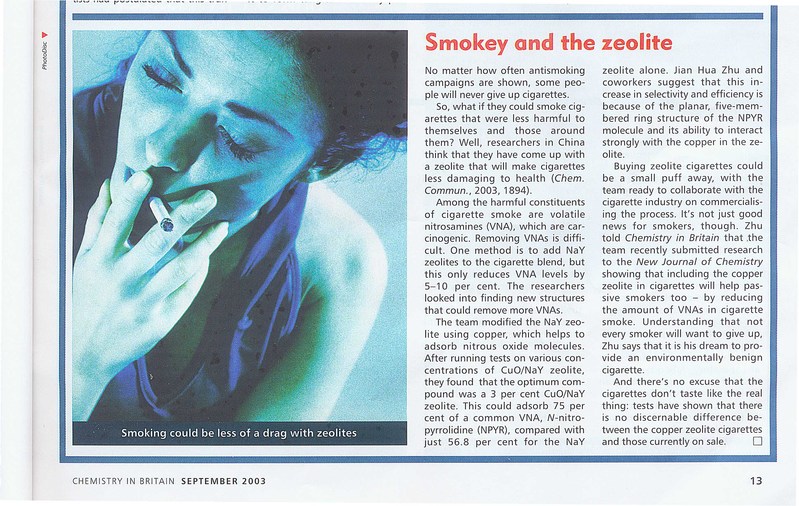
My group pursues innovation and application as the aim of scientific research and prepares many new functional materials to meet the requirements of chemical industry and environment protection. We published 228 papers, 39 reviews and 130 papers of symposium proceeding to date, applying the national invention patent 16 and among them 11 items were authorized. For the first time, we prepared the superbases in China, including some strong basic or superbasic zeolites and mesoporous silica materials. In addition, we revealed the “insert-adsorption” model in the capture of nitrosamines by zeolites, by which some new cigarette additives were developed to control the smoking-caused pollution and the corresponding patent had been transferred. In addition, my team had cooperation on related topics with BAT, Hongta Tobacco group and Shanghai Tobacco group.
Some achievements are as follows: (A) New functional material based on as-synthesized mesoporous silica (1) Efficient adsorbent of CO2 at room temperature with a capacity of 237 mg g-1. (2) Capturer of phenol that trapped almost of all phenol in the high-speed airflow with a capacity of 4.8 mmol g-1, and 18% of the 6 kinds of phenol in cigarette smoke. (3) New releaser of menthol. After loading menthol, it can be stored open for more than 30 days and then released at 80oC (353 K). (4) Efficient releaser of hydrophilic or hydrophobic drug such as heparin (167 mg g-1) or ibuprofen (200 mg g-1) for controllable release of more than 30 days. (B) Super basic zeolites (1) New superbase derived from mesoporous silica or mesoporous alumina with a basic strength of H-=26.5. (2) Superbasic zeolite materials with a basic strength of H-=26.5. (3) Utilization of neutral salt KF to produce a strong basicity on molecular sieve AlPO4-5. (C) Magnesia composites adsorbing carbon dioxide at 473 K (1) The MgO in situ embedded carbon particles had a surface area exceeded 200 m2g-1, and the capability of adsorbing CO2 (28 mg g-1) at 473 K in the high-speed airflow. (2) Zinc oxide replacement improved the surface area of MgO to 296 m2g-1, and 79% of the basic sites could adsorb CO2 at 473 K. (3) Copper modification increased the surface area of MgO up to 240 m2g-1, adsorbing CO2 (35 mg g-1) at 473 K and volatile nitrosamine NPYR. (4) New technology directly produced the MgO with a high surface area up to 278 m2g-1, capturing CO2 (30 mg g-1) in the high-speed airflow at 473 K. (5) Modification of MgO with ferric oxide enabled 90% of basic sites to absorb CO2 at 473 K. (D) New material for adsorption of TSNA in solution (1) Modified mesoporous silica showed a fine geometric confinement. (2) The modified activated carbon with a zeolite-like selectivity to adsorb NNK and to distinguish TSNA from nicotine. (3) Fast sorbent of TSNA and lead ions based on the carbon embedded zinc oxide. (4) The efficient TSNA sorbent derived from waste cigarette butts. Major research projects undertaken in recent years (1) Controlling the pore wall morphology of mesoporous molecular sieve to construct hierarchical structure (2008-2010, national natural science foundation of China) (2) New hierarchical sorbent of carbon dioxide (2008-2010, 863 plan of the state science and technology commission) (3) Controlled release of NO by zeolite materials in simulated gastric juice (2009-2011, national natural science foundation of China) (4) Immobilization and release of heparin in small-caliber artificial vessels with molecular sieves (2012-2015, national natural science foundation of China) (5) New porous solid strong basic materials to capture carbon dioxide in flue gas (2013-2016, national natural science foundation of China) (6) Modified extract and selective removal of some substances of tobacco flake coating liquid (2013-2014, Shanghai tobacco group) (7) Expanding the function of molecular sieve to construct selective adsorption sites in activated carbon materials (2017-2020, national natural science foundation of China) Representative academic papers in recent years (1) Multiply functionalization of mesoporous silica in one-pot: Direct synthesis of aluminum-containing plugged SBA-15 from nitrate aqueous solutions Adv. Funct. Mater. 2008, 18, 82-94 (2) Efficient CO2-capturer derived from the as-prepared MCM-41 modified with amine Chem. Euro. J. 2008, 14, 3442-3451. (3) One-pot synthesis of potassium functionalized mesoporous g-alumina as novel solid superbase Angew. Chem. Int. Chem. 2008, 47, 3418-3421. (4) Novel functional mesoporous material derived from 3D net-linked SBA-15 Chem. Euro. J. 2009, 15, 6748-6757 (5) Periodic Mesoporous organosilicas: Self-assemble from carbamothioic acid-bridged organosilane precursor Chem. Euro. J. 2009, 15, 8310-8318. (6) A New strategy to synthesize hierarchical mesoporous zeolites Chem. Mater. 2010, 22, 2442-2450. (7) Novel porous MgO sorbent fabricated through carbon insertion J. Mater. Chem. A. 2014, 2 (30), 12014 - 12022. (8) In situ loading of drugs into mesoporous silica SBA-15 Chem. Euro. J. 2016, 22, 6294-6301. (9) New activated carbon sorbent with the zeolite-like selectivity to capture tobacco-specific nitrosamines in solution Chem. Eng. J. 2018, 339, 170-179. (10) Efficiently capturing tobacco specific nitrosamines in solution by Hβ zeolite J. Hazard. Mater. 2019, 365, 196-204. (11) Novel menthol releaser derived from as-synthesized mesoporous silica RSC Advances, 2015, 5 (8), 5494 – 5500. (12) New versatile zincic sorbent for tobacco specific nitrosamines and lead ion capture J. Hazard. Mater. 2020, 383, 121188. Course Name, Time and Place
"zeolite chemistry", as the part of "catalytic chemistry" course, is taught in March and April every year. Syllabus, Examination Requirements
This course is in Chinese teaching, which contains the history and development of zeolite materials, and the synthesis, characterization, adsorption and catalysis of zeolites. The examination will be conducted in the form of closed-book examination,classroom tests, book report and lectures. Teaching Resources
Please connect me directly for the teaching materials. Group
|